Finding the Right Scale
If my construction set is to build complex models that fit into a typical flat, I inevitably need to scale it down. The classic half-inch or even the Merkur ten-millimetre module is just too large.
For a children's toy, this size was optimal, the screws were still a manageable size to handle reasonably, and the models were robust enough to withstand rough play. However, if you start building something more complex, and by complex, I mean a model of around five hundred parts or more (excluding screws, of course), you'll easily exceed a metre in at least one dimension and the weight will tip over ten kilograms. Such a behemoth will undoubtedly make an impression on its own, but justifying the need to display such a grand piece in the living room is something few can manage.
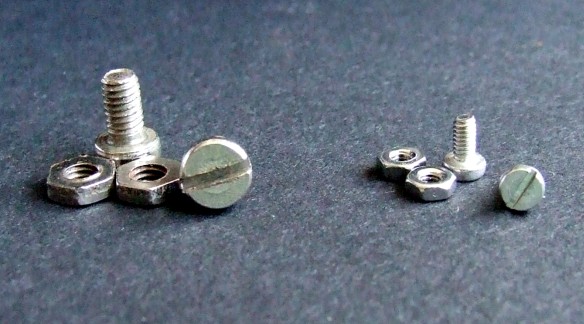
So, scale down, but how? The screws are the limiting factor; working with M2 size is still manageable, but I can't in good conscience call it reasonable. On the other hand, using anything larger is pointless. If we consider even smaller screws, just finding them is a feat, and screwing them in is the next challenge. Ultimately, the deciding factor was cost; while M2 screws cost pennies, M1.6 are priced in pounds, and for M1 size, you often pay more than ten pounds each. Given that I'll need thousands of screws, the choice was quite clear.
I chose classic slotted screw heads, although I considered cross-head for a long time, but they just looked too modern. Plus, slotted heads are slightly smaller than Philips, which is definitely a plus. The hole spacing module is derived from the screws. It works out well at a quarter inch or six millimetres, with only a three-tenths difference between them. I draw prototypes as six millimetres because I can't think in inches, but in some cases, like when joining with angle brackets, I think those few extra tenths would be useful. If screws are placed in opposite holes, they almost touch. So, I might change the module from six millimetres to a clean quarter inch; I haven't decided yet.
Either way, the set will be half the size of half-inch sets and slightly more than half the size of Merkur. Additionally, I've chosen polished stainless steel as the main material. It certainly won't be a toy for children.
2 July 2015