Gears and Wheels
The wheels are where the TRIX inspiration is most evident. The idea is that traditional axles are replaced with studs (threaded rods). This means you don't need pressed hubs on the wheels to attach them to the axles. You can simply secure them with two nuts, or leave them free between nuts with a locknut if you need a rotating wheel on the axle.
Initially, I was a bit concerned about the rotation of the threaded rod in the hole, its load-bearing capacity, and whether it would seize up. After testing, I concluded that at this scale, there's no difference between a smooth and a threaded axle. Theoretically, there should be a difference, but practically, it doesn't show.
By screwing two discs with flanges together, you get the base for a wheel with a tyre, and this base can have various widths. From the same disc, you can also create a perfect railway wheel. This isn't possible with a wheel like Merkur/Meccano, because the hub has to be pressed over both parts of the wheel together, making it non-detachable and with a fixed width. Overall, this system is very versatile. With just a few parts, you can assemble many wheels of different diameters and widths, with or without tyres, fixed to the axle or freely rotating, with a solid disc or with spokes. Of course, the fact that there's no need to machine hubs and then press them onto wheels is a big technological advantage, just as it is that only eight types of metal parts are needed.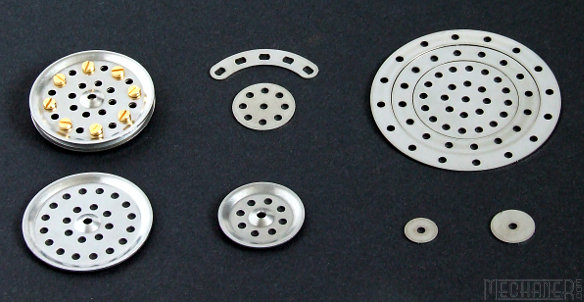
However, with flanged wheels, you can't entirely avoid pressing, even when making prototypes. The blanks were laser-cut like the other parts, but the final shape had to be formed in a two-part pressing jig. It's pressed under a simple hand-operated hydraulic press with a force of about one and a half tonnes. Although the jig design was aimed at keeping costs low and each insertion of the blank and removal of the finished wheel requires opening the jig, the work goes quite smoothly. I managed about four pieces per minute, so they could temporarily be used for starting a small series. 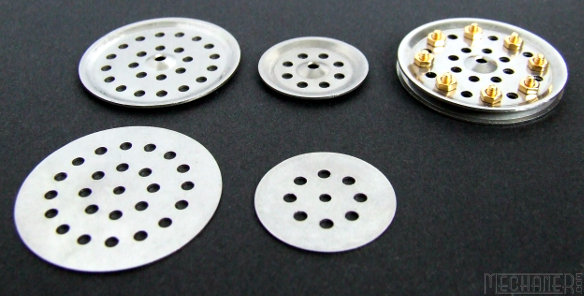
The biggest problem so far is the tyres. For the smallest diameter, ordinary 8mm thick o-rings fit very nicely, but for larger diameters, a thickness of twelve or more would be better, as the proportions don't quite match with eight millimetres. Unfortunately, these are sizes outside the standard, and while such non-standard o-rings can be bought, they come at an absolutely exorbitant price.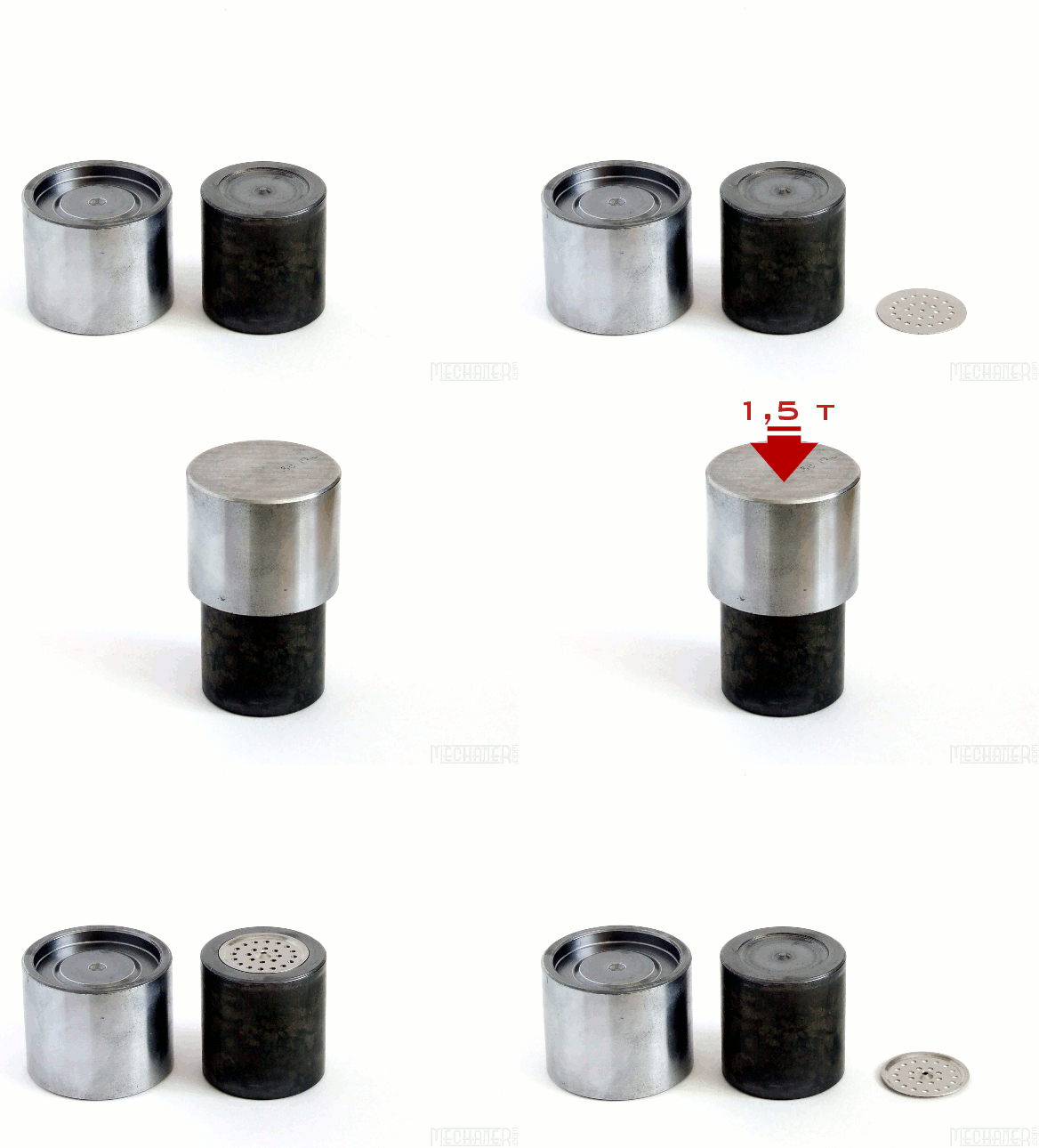
19 July 2015