Small Parts Require Small Tools
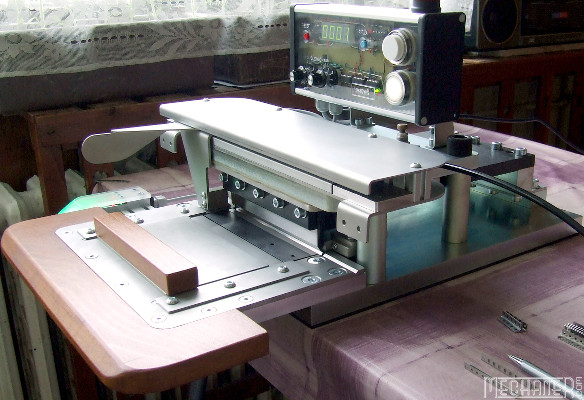
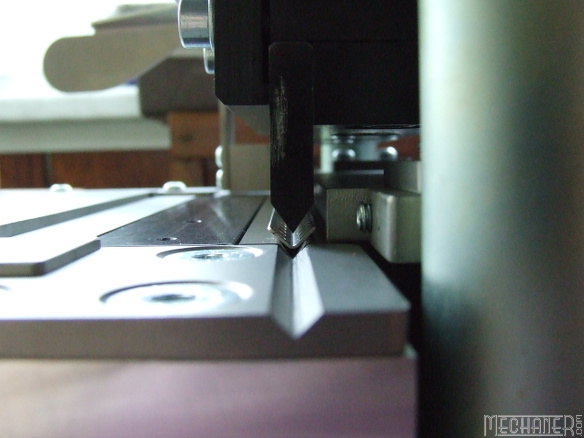
Bending a sheet metal bracket is a straightforward task, but only from a certain size onwards. Punches that can handle a bend with a radius smaller than 0.6mm are not something you typically find lying around. Sure, you can order them, but even if you overlook the cost of several thousand euros, you're faced with the challenge of inserting a piece that's often so small you can easily cover it with your finger. So, like it or not, I set about building a custom press brake.
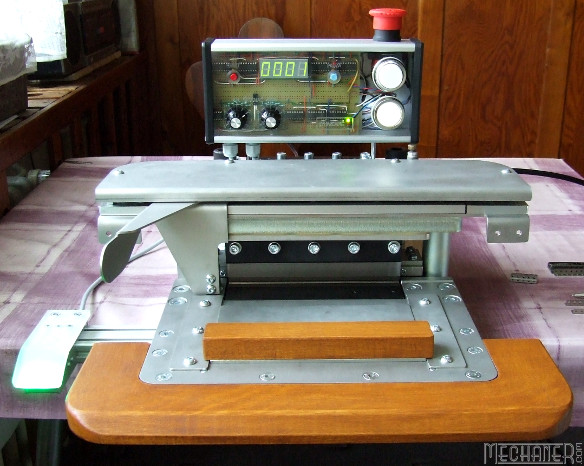
The design is very simple. The punch is mounted on a long swinging arm, working much like a paper stapler. With a stroke of just three millimetres, the movement is practically linear, not to mention that with such a small stroke, there's no risk of getting your fingers caught and pinched. The pressure is provided by a large pneumatic bellows.
In appearance and operation, the press brake resembles a typewriter. You insert the piece to be bent into the machine and use a sliding ruler to press it against the adjustable backstop. You press the large illuminated button on your left and wait for the piece to be bent. The force, stroke, speed of the punch, and pressing time are all adjustable. You eject the finished piece from the machine with a similar lever and the same motion used to advance a line on a typewriter.
I aimed for the cheapest possible construction, so where possible, laser cut parts are used, and the rest is made from simple milled blanks with a few holes. A major mistake was the custom electronics, cobbled together from discrete gates and timers, which, while they work as intended, cost me an absurd amount of time and energy. A standard PLC should have been used; it would have been much clearer and ultimately cheaper.
28 March 2016