I Want to Make My Own Construction Set
Metal construction sets have been around for ages, so long that they're not even retro anymore, but rather pure steampunk. They originated in England at the end of the 19th century, and boys played with them for a whole century before plastics and the fear of manual labour took over in developed countries.
I had my own metal construction set too, received it for Christmas when I was ten. It was a beautiful three-tiered Merkur. Explaining what Merkur is to Czechs is pointless, of course, as it was a staple toy every lad had, and there wasn't any other similar set available here. But since the internet is vast and Google can translate many languages, I'll add that Merkur is one of many copies of Meccano (or Erector, if you're from another part of the world) that popped up in the 1920s after Frank Hornby's original patents expired. The main difference is that, unlike most, it doesn't use the classic half-inch hole spacing but a ten-millimetre one. I think that was quite a bold decision, as it made the set incompatible with everything else. Interestingly, even sets made in the Soviet Union adhered to the half-inch module.
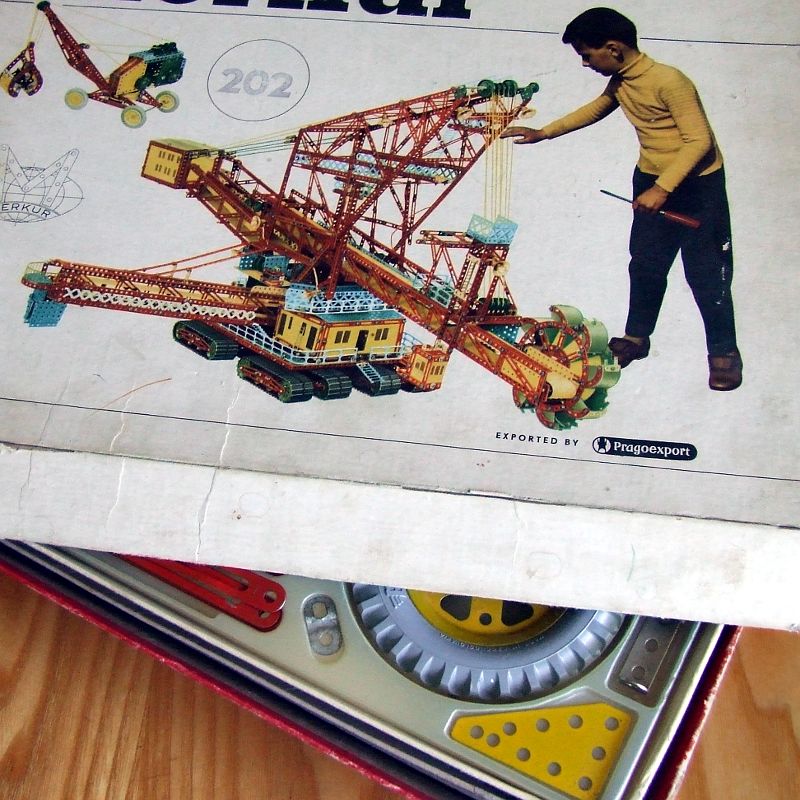
So there I was, ten years old, with my Merkur, and I was thrilled. The set came with a big book of models featuring a large mining excavator on the cover, which I really liked and regretted not having enough parts to build. I don't know about you, but I stubbornly built only the models from the back pages of this book because they were the nicest and most complex. However, I was only ten, and there weren't enough pieces in the box to build these models, so they never ended up looking as good as in the pictures. That's why most of my childhood memories of Merkur are a bit mixed.
The second set that captivated me, I never actually saw in person. Somewhere, I don't even know exactly where, but for some unknown reason, I think it was at the centennial exhibition in Prague, I got my hands on a catalogue from the company TRIX. It was purely a train catalogue, but on the back cover was a large picture of a Bugatti built from their set. The model itself is impressive, but what really struck me was the boldly metallic look, so typical of this set. The combination of silver parts, brass screws, and the occasional yellow paint on some details looks simply stunning. It's also perhaps the only set where metal parts are truly treated as metal, being bent and shaped as needed. There's much to be said about TRIX, its thoughtfulness, and the technical sense that radiates from every catalogue and model, and I might write more about it in the future.
So, what would I like? I'd love a set with the technical metal aesthetics of TRIX, but based on a more traditional right-angled module of parts. A set from which large, complex models could be built, yet still fit into a normal flat. Wouldn't you like such a set?
28 June 2015